
🎯 When AI Writes Too Well, Do Students Learn Less?
What Google’s new tools (and decades of research) remind us about how real learning happens.

AI can write. Really well.. and really fast.
That’s impressive… especially for students staring down a blank page.
But as AI tools flood into classrooms and study routines, there’s a growing question worth asking:
Are we learning more… or just writing faster?
Google seems to be thinking about this too. Its new tools, like Gemini’s Writing Coach and NotebookLM, aren’t just there to spit out full essays.
They’re designed to help students work through their ideas… before hitting “generate.”
It’s a quiet but important shift: from AI as a “shortcut” to AI as a “thinking partner.”
And that shift aligns with something educators and scientists have known for a long time:
Learning doesn’t start with writing. It starts with thinking.
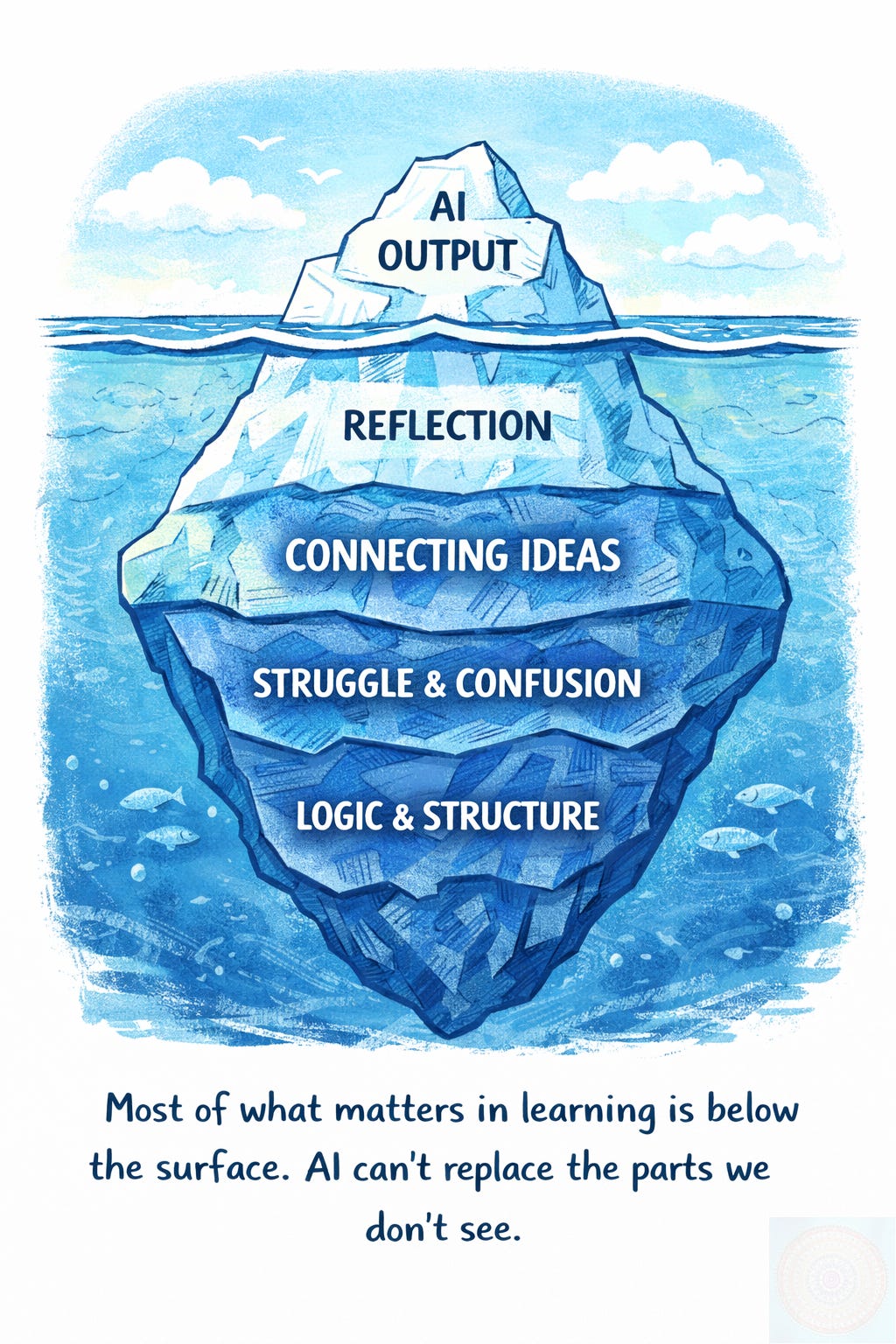
🧠 Struggle isn’t a flaw. It’s how learning works
It might not feel great in the moment, but…
Wrestling with a tough concept or trying to reflect on ideas is exactly what helps learning stick.
This idea is backed by Cognitive Load Theory (Sweller, 2011), which says that while it’s helpful to remove distractions, taking away the actual mental effort of understanding can do more harm than good.
Struggle isn’t just noise… it’s the work.
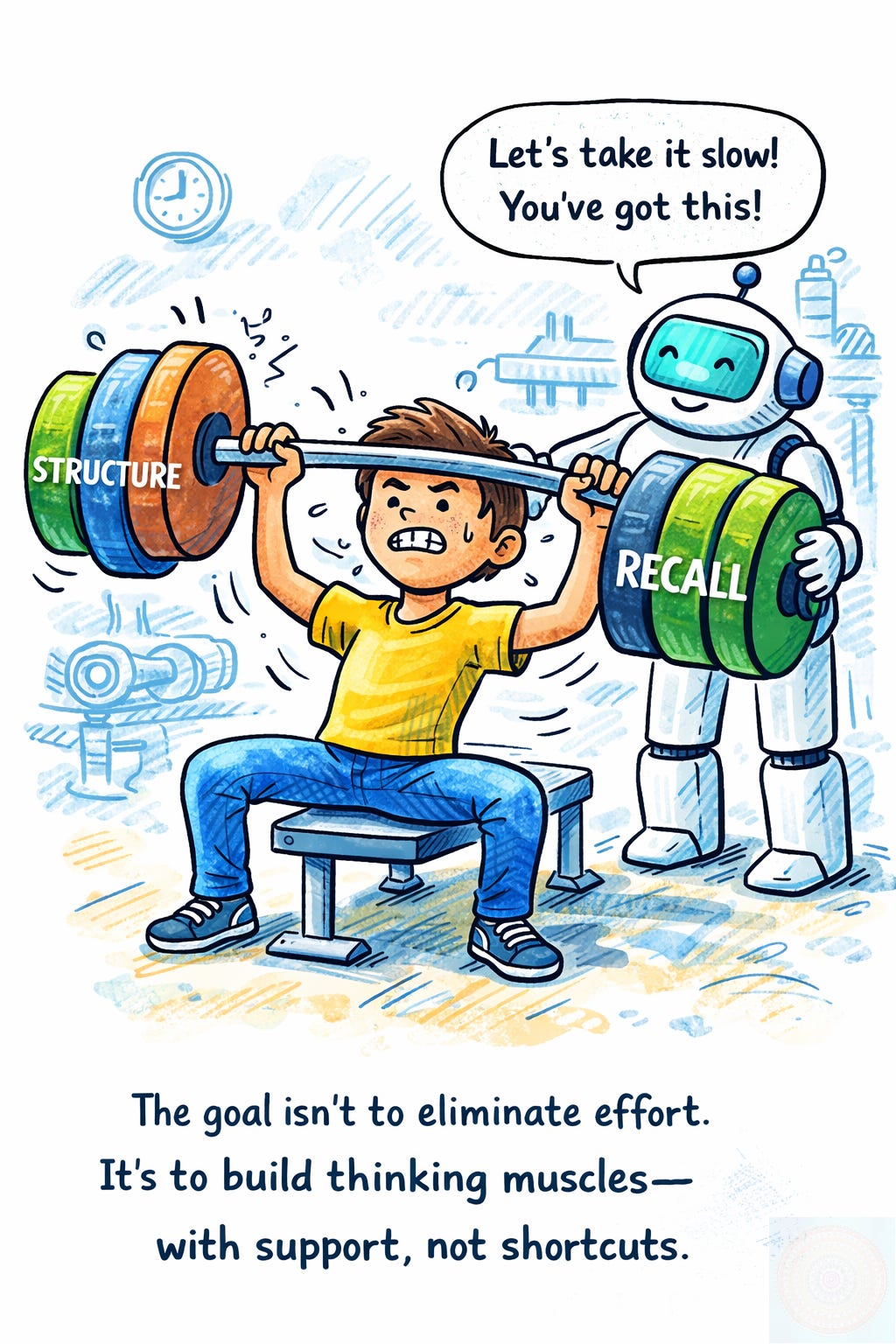
In a recent 2025 study, students who used AI to summarize course content wrote faster… but remembered less (Shiri Melumad & Yun, 2025). They looked more productive but scored up to 25% lower on deeper learning assessments than peers who processed the material on their own.
Speed is great… until it replaces depth.
🧱 Before words, there’s structure
Before students can write clearly, they usually need to think clearly.
That means sorting through what they know, making connections, and figuring out what matters.
The Somagraphic Learning Framework is one way to describe this process. It focuses on the idea that cognitive sense-making comes before language or AI output.
Through sketching, mapping, or simply organizing thoughts in space. It’s not about visuals for the sake of visuals. It’s about giving shape to ideas before they’re turned into sentences.
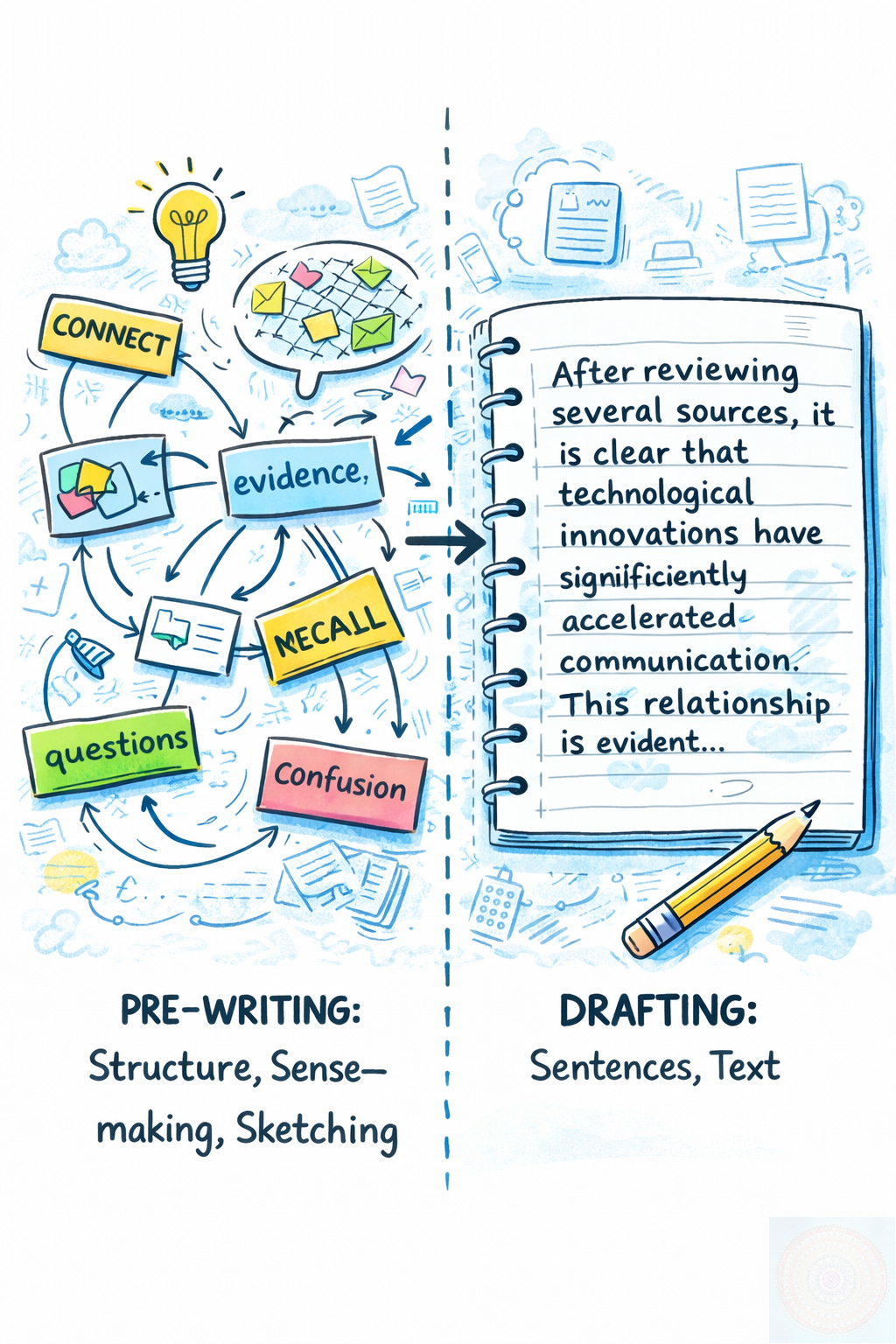
This is why tools like Gemini’s NotebookLM are interesting: they help students bring in their own materials, organize them, and work through their thinking.
That kind of effort, even when it feels slow, leads to longer-lasting understanding. Psychologists call it desirable difficulty (Bjork & Bjork, 2020) and it’s been shown to boost both memory and adaptability.
🤖 What better AI support looks like
Some AI tools are starting to get this right… not by giving answers, but by asking better questions.
Research on feedback in education (Hattie & Timperley, 2007) shows that guidance focused on how to think or improve… rather than just what’s right or wrong… is far more effective. It helps students reflect, adjust, and actually learn.
When AI offers that kind of process-focused support, it becomes a useful nudge rather than a crutch.
🎯 It’s not about more writing. It’s about “better” thinking.
AI is here, and it’s getting better by the week. But in education, better doesn’t just mean faster or more polished. It means learning that sticks. Skills that transfer.
Ideas that make sense not just in the moment, but when the test (or real life) shows up later.
The goal isn’t to stop using AI in learning. It’s to design it… and use it—in ways that protect the parts of thinking that matter most.
Because in the end, the best outcome?
Isn’t a clean page. It’s a clearer mind.
Somagraphic Learning is an IP-protected framework bridging Soulful Learning with human-centered AI. It is available for pilots and strategic collaborations with educators, institutions, and EdTech teams.
Contact me here for more information.
🧩 Substack: Soulful Learning with AI
🤝 LinkedIn: Devika Toprani
The goal of this collaboration is not to replace AI, but to ensure that while AI provides answers, humans still do the learning.
References
Bjork, R. A., & Bjork, E. L. (2020). Desirable Difficulties in Theory and Practice. Journal of Applied Research in Memory and Cognition, 9(4), 475–479. https://doi.org/10.1016/j.jarmac.2020.09.003
Hattie, J., & Timperley, H. (2007). The Power of Feedback. Review of Educational Research, 77, 81–112. https://doi.org/10.3102/003465430298487
Shiri Melumad, & Yun, J. H. (2025). Experimental evidence of the effects of large language models versus web search on depth of learning. PNAS Nexus, 4(10), pgaf316–pgaf316. https://doi.org/10.1093/pnasnexus/pgaf316
Sweller, J. (2011). Cognitive Load Theory. Psychology of Learning and Motivation, 55, 37–76. https://doi.org/10.1016/B978-0-12-387691-1.00002-8
I think this is such an important article. So many people rally against AI. But it is here. And it does have real life uses that can help us if we use it responsibly, just like any tool.
WE created this and we are the ones who need to decide how it will supplement our future. Just like any technological advancement before…
Thank you so much for sharing 🩵
Amazing Read….