
Somatic Mirroring: A Protocol for Human-AI Collaboration
Reclaiming the "Earned Struggle" of Learning

Right now, talking to AI is like trying to squeeze a big, messy idea through a tiny keyhole.
We have complex thoughts, but we are forced to turn them into simple text boxes.
For kids growing up today (Gen Alpha), this is a double-edged sword.
If the AI does all the heavy lifting and provides the answers too easily, the student might stop “exercising” their brain.
Real learning usually requires a bit of a struggle… an “earned” effort.
The big question is: How do we use AI without losing the hard work that actually helps us learn?
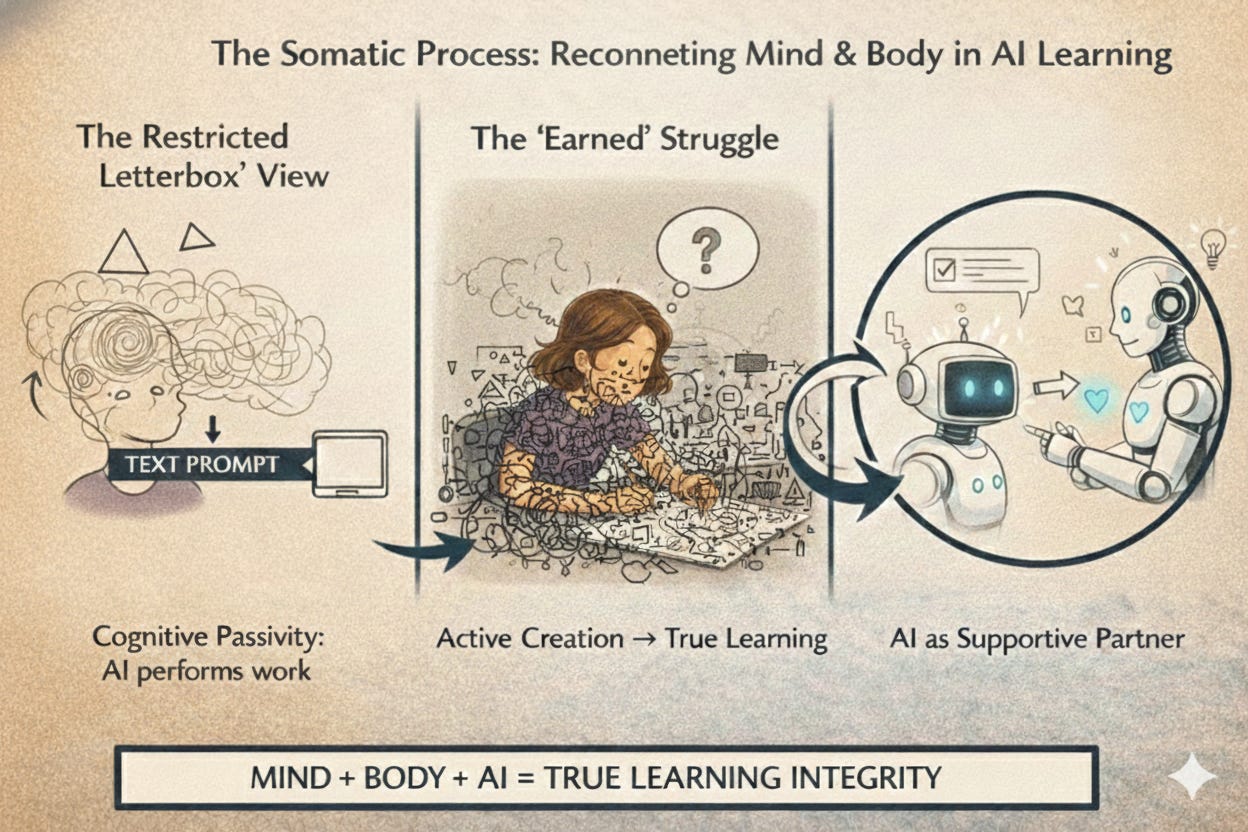
To protect the integrity of the learning process, the interface must reconnect with the body.
The Somatic Process of Somagraphic Learning is designed to meet this “EARNED” struggle.
It ensures that technology remains a supportive partner to the human spirit.
Shape Emotion Grammar: A Foundation of Understanding
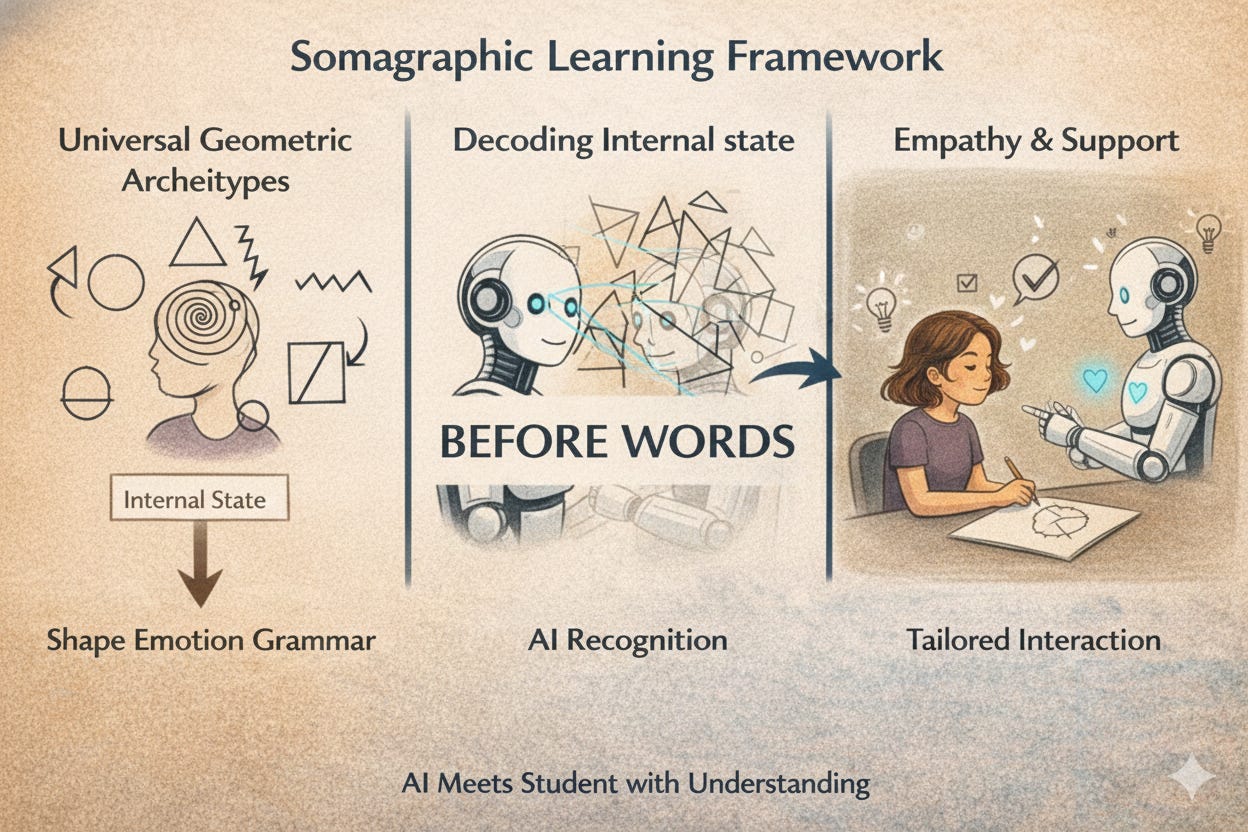
This framework is built upon a rigorous Shape Emotion Grammar. By utilizing universal geometric archetypes, the system decodes a learner’s internal state.
This happens before a single word is typed.
It allows AI to meet the student with appropriate empathy and technical support.
Theoretical Grounding
Circle → Safety: Grounded in Psychological Safety and Attachment Theory (Bar & Neta, 2006; Bowlby, 1969). Curves signal a lack of threat. This prompts the AI to respond with warmth.
Square → Structure: Drawing from Schema Theory and Cognitive Framing (Bartlett, 1932; Goffman, 1974). These forms indicate a mind seeking order. The AI responds with logical, structured guidance.
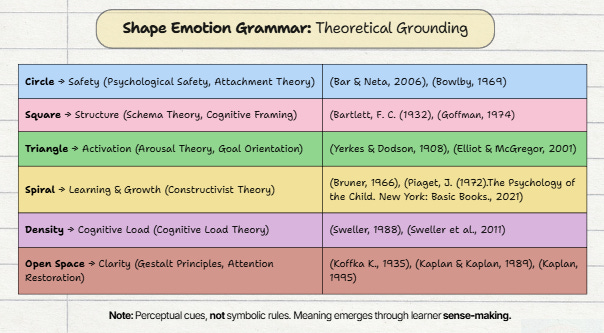
Triangle → Activation: Linked to Arousal Theory and Goal Orientation (Yerkes & Dodson, 1908; Elliot & McGregor, 2001). Sharp angles suggest high focus. The AI provides a more rigorous challenge in response.
Spiral → Learning & Growth: A pillar of Constructivist Theory (Bruner, 1966; Piaget, 1972). The spiral reflects an iterative journey. It represents building new knowledge upon established foundations.
Density → Cognitive Load: Informed by Cognitive Load Theory (Sweller, 1988). Tangled or heavy strokes signal an overwhelmed mind. This allows the AI to pause and simplify the content.
Open Space → Clarity: Based on Gestalt Principles and Attention Restoration (Koffka, 1935; Kaplan, 1995). Expansive space reflects an open mind. It signals that the learner is refreshed and ready for insight.
The Somatic Mirroring Process
Body → Effort → Observation → Reflection → Refinement
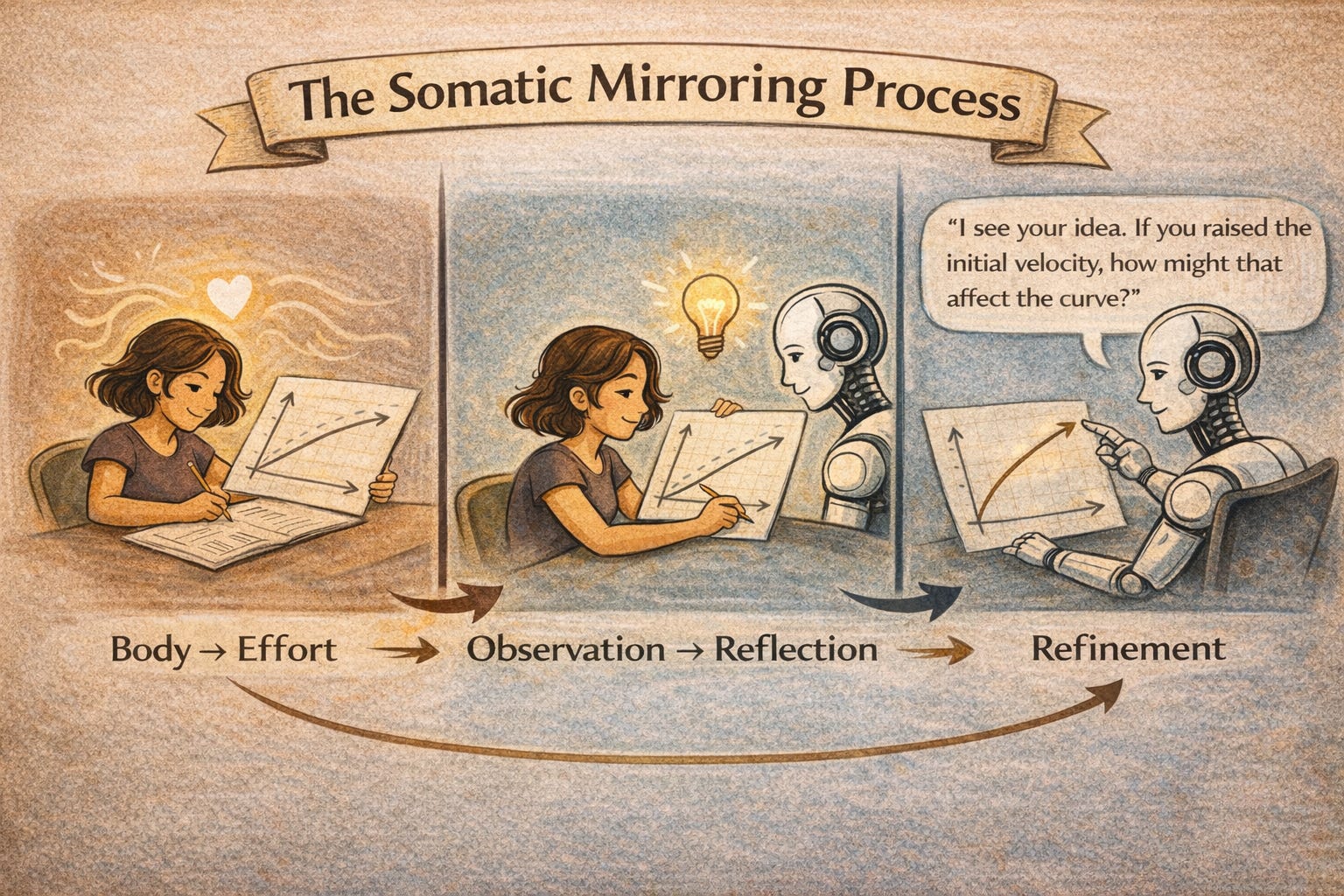
Instead of typing, the learner “draws” the shape and energy of their thoughts. ✍️
The learner uses a camera with AI to capture these non-verbal movements, letting the body express the idea before using any words.
AI senses the “Cognitive Pulse” 🤖
AI “watches” the learner’s creative rhythm through the camera.
It doesn’t just look at a final drawing; it mirrors the learner’s focus and the physical effort put into the movement to understand their true intent.
AI issues a “Biometric Receipt” 🧾
The system automatically creates a digital “proof of work.” This confirms the learner spent real time and physical energy building the idea.
This receipt can be seamlessly integrated into Learning Management Systems (LMS) and existing EdTech platforms, providing teachers with verified evidence that the work is authentically theirs.
The learner achieves “Soulful Insight” ✨
Because the learner did the “earned struggle” first, the AI now helps refine a thought that is already theirs.
The result is an idea “gestated” by the learner’s soul, not just a generic answer generated by a bot.
Seamless Integration: The Future of EdTech
The Somagraphic Framework is designed for the modern classroom. It can be integrated directly into existing LMS (Learning Management Systems) and EdTech platforms.
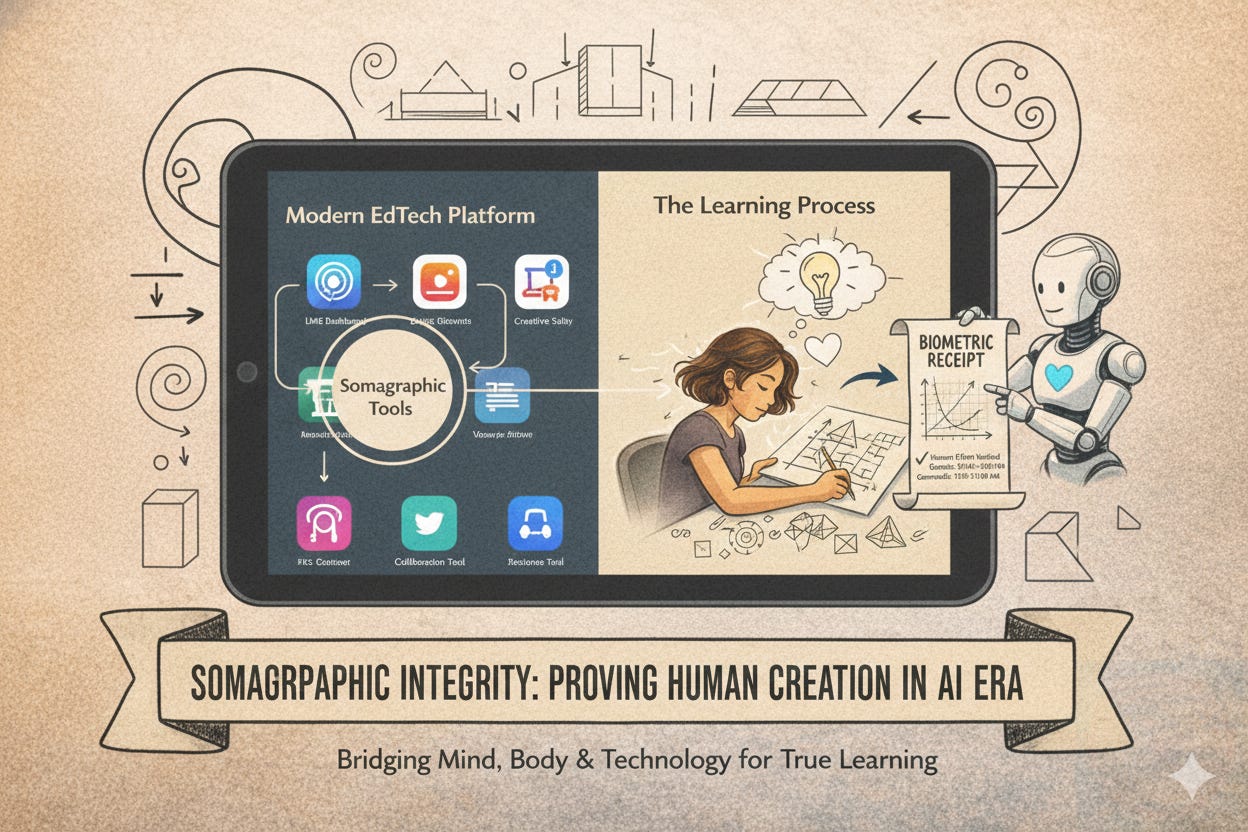
By embedding these somatic tools into the apps students already use, we create a new standard for academic integrity.
A Vision for Gen Alpha
Gen Alpha will grow up with AI as a constant companion. We must ensure they remain the architects of their own education.
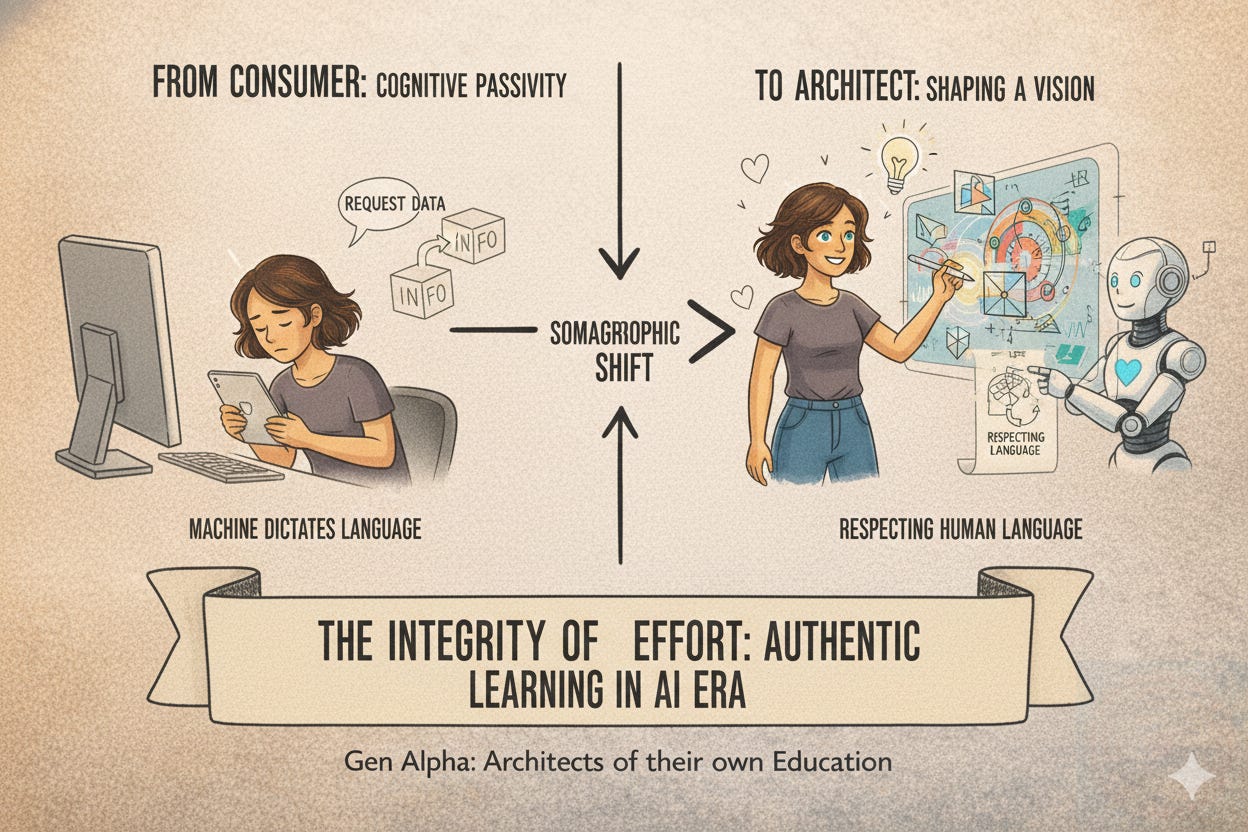
From Consumer to Architect:
This framework shifts the student’s role. They move from “requesting data” to “shaping a vision.”
The Integrity of Effort:
We move away from forcing children to speak the language of machines. Instead, we teach machines to respect the language of humans.
The goal of education is not just to be more efficient than AI. It is to remain deeply, authentically human.
Because ultimately, learning is…
Not AI-Made. It’s SOUL-Made.
Let’s connect!
The Somagraphic Framework™ is IP-Protected and currently open for research pilots and strategic collaborations.
I am also seeking full-time roles in the US (F1 OPT, STEM degree) or UAE (Golden Visa holder).
If this somatic, human-centered approach to AI aligns with your organization’s vision for Gen Alpha and the future of work, I would welcome a conversation.
🤝 LinkedIn: Devika Toprani
© Somagraphic Learning. Devika Toprani, 2025 All Rights Reserved. US Copyright Pending.
References
Bar, M., & Neta, M. (2006). Visual elements of subjective preference. Psychological Science, 17(8), 645–648.
Bartlett, F. C. (1932). Remembering: A study in experimental and social psychology. Cambridge University Press.
Bowlby, J. (1969). Attachment and loss: Vol. 1. Attachment. Basic Books.
Bruner, J. S. (1966). Toward a theory of instruction. Harvard University Press.
Elliot, A. J., & McGregor, H. A. (2001). A 2 x 2 achievement goal framework. Journal of Personality and Social Psychology, 80(3), 501–519.
Goffman, E. (1974). Frame analysis: An essay on the organization of experience. Harvard University Press.
Kaplan, R., & Kaplan, S. (1989). The experience of nature: A psychological perspective. Cambridge University Press.
Kaplan, S. (1995). The restorative benefits of nature: Toward an integrative framework. Journal of Environmental Psychology, 15(3), 169–182.
Koffka, K. (1935). Principles of Gestalt psychology. Harcourt, Brace.
Piaget, J. (1972). The psychology of the child. Basic Books.
Sweller, J. (1988). Cognitive load during problem solving: Effects on learning. Cognitive Science, 12(2), 257–285.
Sweller, J., Ayres, P., & Kalyuga, S. (2011). Cognitive load theory. Springer Science & Business Media.
Yerkes, R. M., & Dodson, J. D. (1908). The relation of strength of stimulus to rapidity of habit-formation. Journal of Comparative Neurology and Psychology, 18, 459–482.
Great and perceptive piece. You start with the ultimate question: How do we use AI without losing the hard work that actually helps us? And then you do an excellent job of addressing it
What an absolutely stellar an accessible Blueprint for the future of learning. Bookmarking so I can re-read.