
🧠 Somagraphic Learning in the Cognitive Age
A Human Architecture for Sense-Making, Judgment, and Safeguards


The Shift We Are Not Naming Clearly Enough
Information is no longer scarce.
Judgment is.
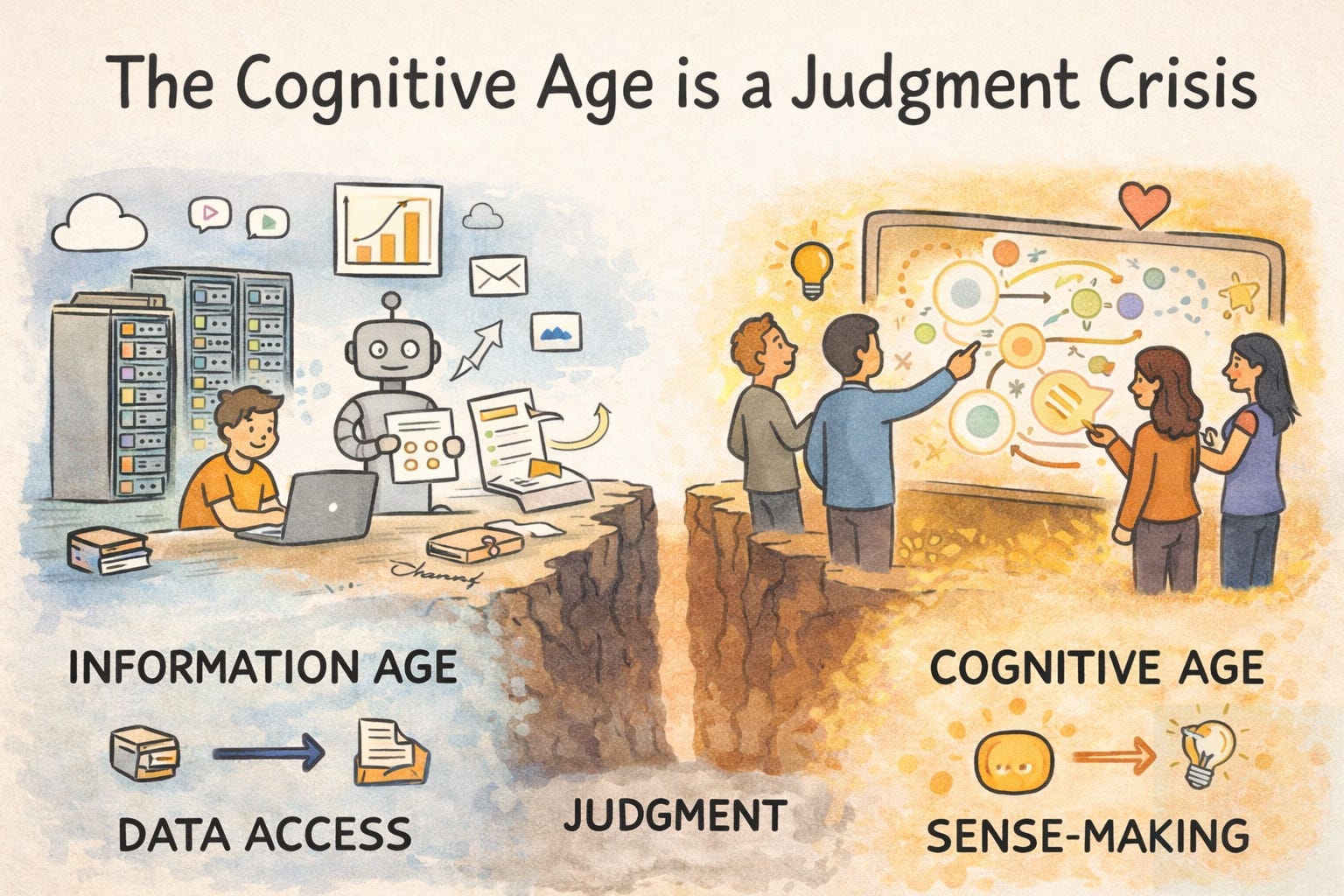
The transition from the Information Age to the Cognitive Age is not primarily technological.
It is epistemological.
The Information Age optimized access: more data, faster retrieval, broader distribution. Artificial intelligence now performs these functions more efficiently than any human system ever could.
The defining constraint of the Cognitive Age is the human capacity to integrate signals, regulate emotion, anticipate consequences, and act coherently in systems that no longer behave linearly. Complex domains cannot be managed through ordered-domain logic (Snowden & Boone, 2007). Feedback, emergence, and non-linearity dominate (Meadows, 2008; Sterman, 2000).
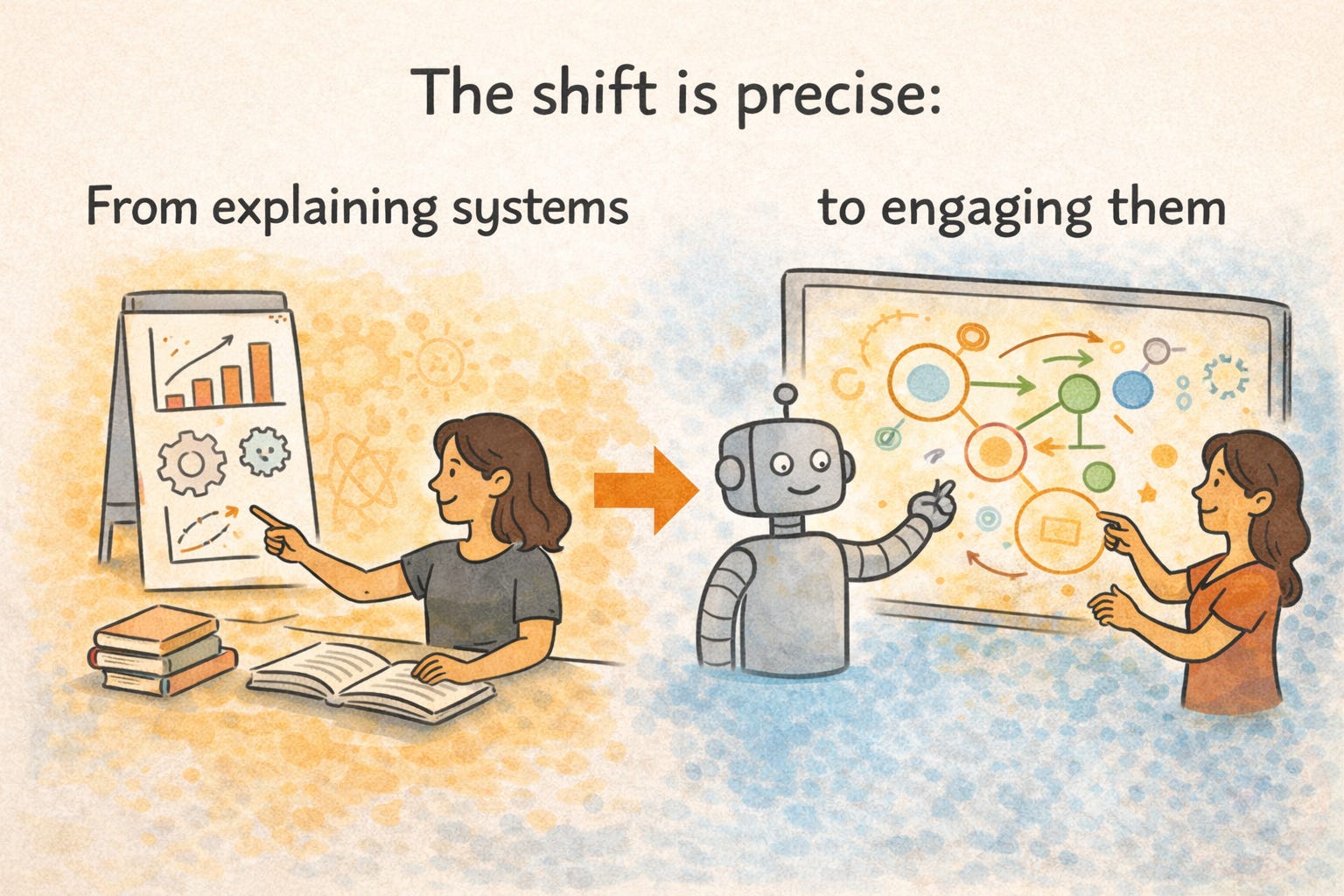
This pressure lands first on the nervous system… and only later on institutions.
Education, however, remains industrial. It privileges sequence over simultaneity, abstraction over interaction, and memory over structural fluency.
These models were built for stability.
They fracture under acceleration.
Somagraphic Learning emerges as a necessary adaptation. It is not aesthetic. It is architectural.
It integrates embodied sensing with visual structure, allowing learners to metabolize complexity without overwhelming semantic bandwidth.
It enables four non-negotiable capacities of the Cognitive Age:
Systems Thinking
Emotional Intelligence
Strategic Foresight
Anticipatory Governance
And it depends on a fifth: safeguarding cognitive and emotional sovereignty in digital environments.
Somagraphic Learning: A Human-First Cognitive Architecture
Somagraphic Learning begins from a well-established premise in cognitive science: cognition is embodied (Barsalou, 2008; Lakoff & Johnson, 1999; Varela, Thompson, & Rosch, 1991).
Meaning is not constructed solely through symbolic manipulation. It arises from perceptual systems, bodily states, and situated interaction.
Visual reasoning is not illustrative. It is structural (Arnheim, 1969). Somagraphic methods externalize complexity into spatial form - boundary, pattern, force, relation.
When learners interact directly with structure, they bypass unnecessary symbolic friction. Experiential modeling consistently outperforms static abstraction in complex systems (Sterman, 2000).
Systems Thinking: Making Complexity Intuitive
Systems Thinking is foundational in the Cognitive Age. Yet it is consistently mislearned.
Feedback loops, circular causality, and emergence operate simultaneously (Meadows, 2008). Text forces them into sequence.
The result is conceptual familiarity without structural intuition.
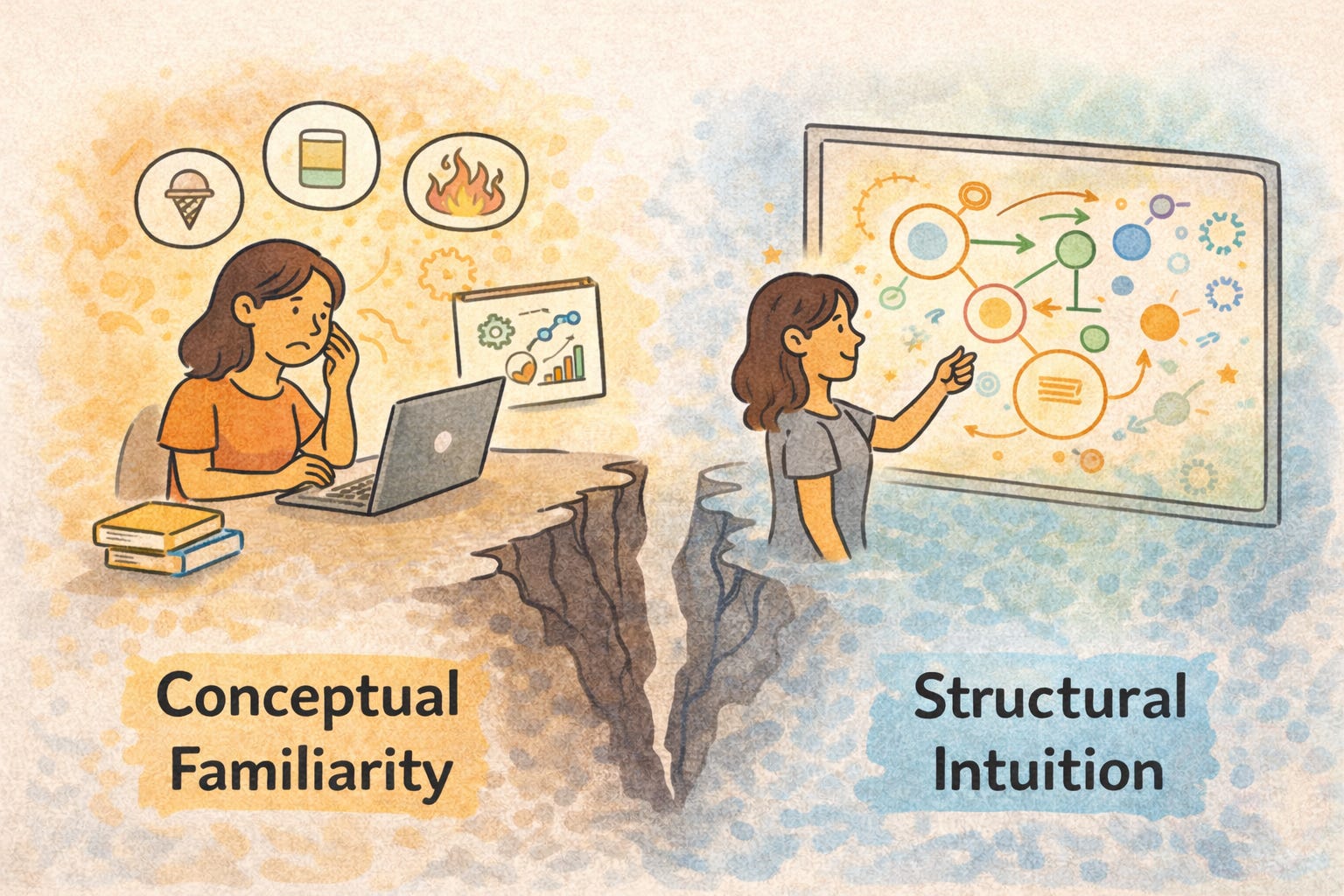
Somagraphic Learning resolves this representational mismatch.
Core system patterns (distinction, relationship, system, perspective) correspond to embodied experience. Boundaries are bodily. Perspective is positional. Force is felt before it is calculated.
Participatory simulations and agent-based visual environments make feedback visible and emergence observable (Sterman, 2000). When recursion encloses itself spatially, it becomes evident. When distributed agents follow simple rules, large-scale patterns become legible.
Responsible visual representation clarifies structure without distortion (Tufte, 2001). Complexity becomes perceptible rather than abstract.
Emotional Intelligence: The Grammar Beneath Language
Emotional intelligence is not peripheral.
It is infrastructure.
Emotion is integral to reasoning (Damasio, 1994). Affective processing precedes conscious articulation. Judgment depends on integrating emotional signals with cognitive evaluation.
Somagraphic Learning aligns with this ordering.
Visual inquiry practices train learners to separate observation from projection. In complex domains, premature categorization generates error (Snowden & Boone, 2007). Slowing perception increases calibration.

When multiple interpretations coexist without forced closure, learners internalize perceptual partiality. That recognition underwrites empathy and ethical restraint.
Somagraphic methods also provide a pre-verbal grammar for emotion. Internal states can be mapped visually. Visibility creates distance. Distance enables regulation.
In contrast to digital systems that commodify behavioral and emotional data (Zuboff, 2019), this approach preserves dignity and autonomy.
The aim is stability, not optimization.
Strategic Foresight: From Prediction to Preparedness
Traditional forecasting assumes continuity.
Non-linear systems invalidate that assumption (Meadows, 2008).
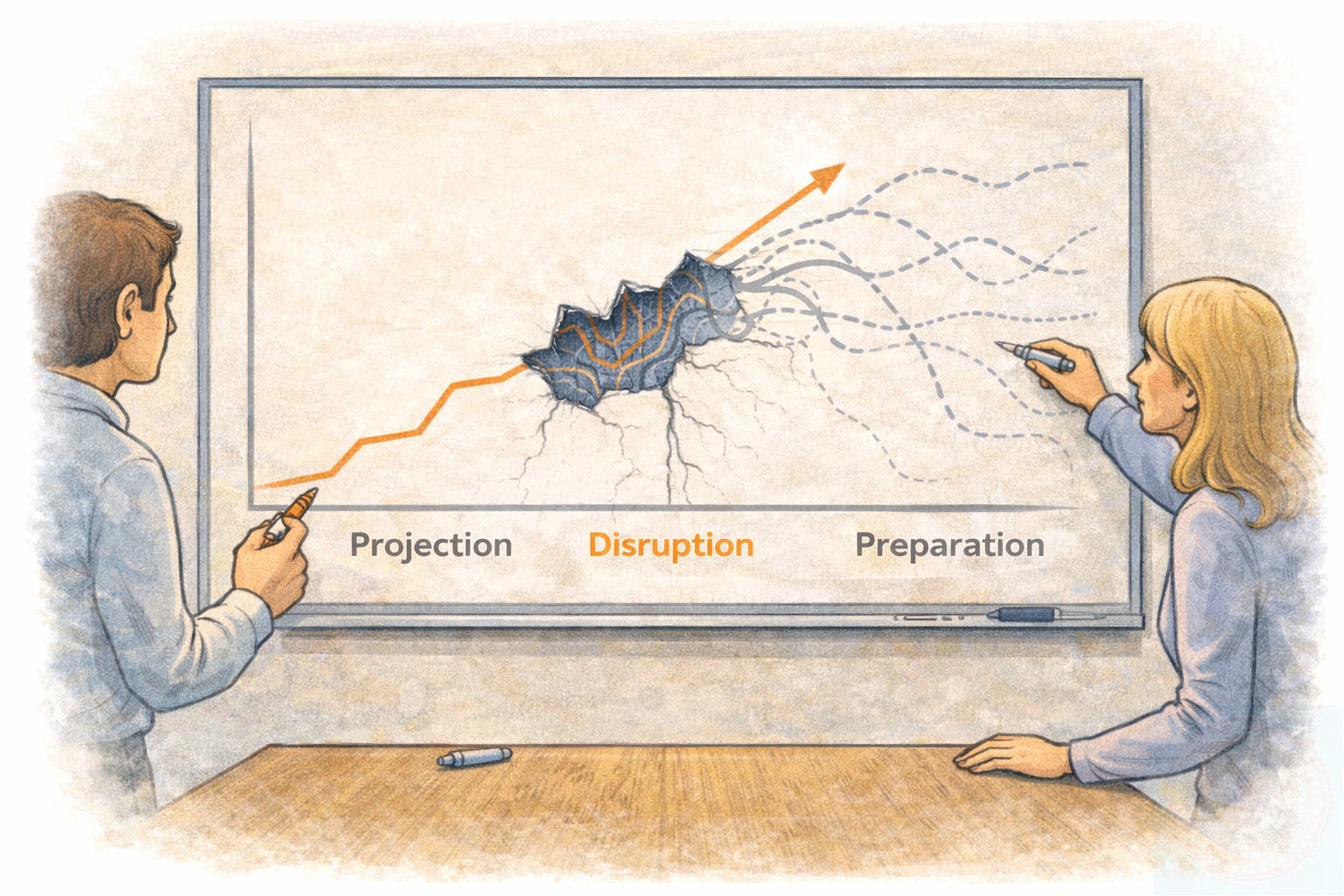
Strategic foresight in the Cognitive Age therefore prioritizes preparedness over prediction (Schwartz, 1996).
Structured future methodologies cultivate disciplined imagination (Inayatullah, 2008; Ramírez & Wilkinson, 2016). When possible futures are externalized into artifacts, tensions become tangible. Ethical implications surface earlier.
But foresight requires reflexivity. Without reflexivity, internal anxiety masquerades as a signal. Anticipatory governance integrates foresight with iterative reflection and inclusion (Guston, 2014).
Preparedness replaces premature certainty.
Anticipatory Governance: Seeing Together Before Acting
Governance challenges in complex systems are systemic and contested.
Anticipatory governance integrates foresight, reflexivity, and public engagement to navigate uncertainty (Guston, 2014).
Somagraphic methods externalize mental models into shared visual structures. These function as boundary objects across expertise and ideology (Snowden & Boone, 2007).

When participants can point to structure rather than defend position, disagreement shifts from identity conflict to systemic inquiry.
Organizational learning depends on shared models made explicit (Senge, 2006).
Participation expands beyond rhetorical dominance. Drawing, mapping, and modeling allow values to surface without privileging fluency.
Inclusion becomes operational.
Safeguarding the Learner in Digital Contexts
Somagraphic Learning engages deeply personal signals - emotional, perceptual, creative.
In digital systems, such signals risk becoming extractive assets (Zuboff, 2019).

Human-centered learning requires contextual integrity (Nissenbaum, 2010). International policy frameworks increasingly affirm this principle (OECD, 2021; UNESCO, 2023).
Non-negotiables include:
Data minimization
Local processing
Federated architectures
Explicit rejection of biometric surveillance in education
Ethical responsibility in informational environments is foundational (Floridi, 2013).
The objective is sovereignty.
Integration
The four capacities of the Cognitive Age (systems thinking, emotional intelligence, strategic foresight, anticipatory governance) share a single requirement:
Orientation under complexity.
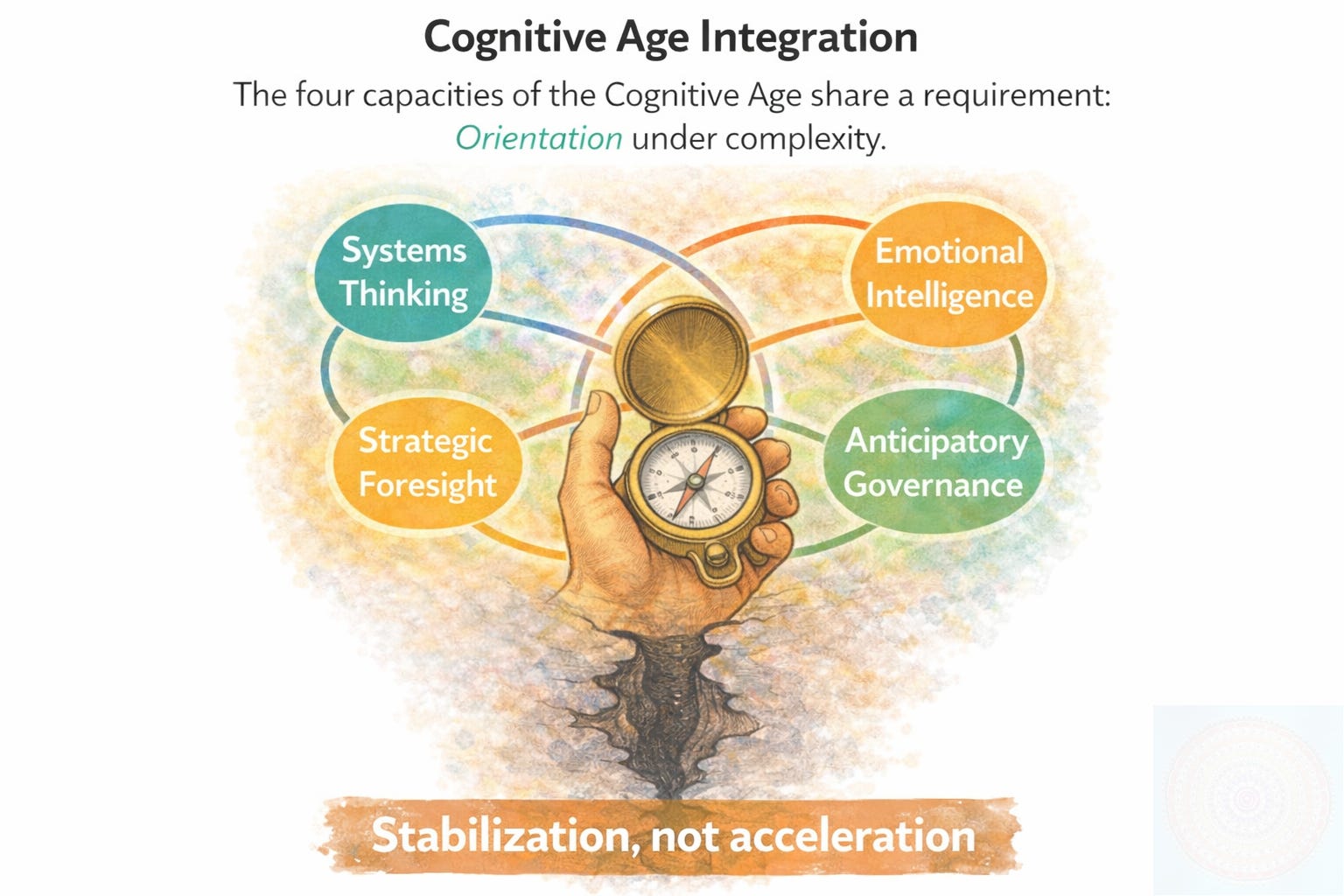
Somagraphic Learning aligns pedagogy with embodied cognition (Barsalou, 2008), structural literacy (Meadows, 2008), visual reasoning (Arnheim, 1969), and anticipatory governance (Guston, 2014).
It does not accelerate the learner.
It stabilizes them.
Without stabilization, intelligence (human or artificial) does not produce wisdom.
The theoretical foundations are established.
The methodological tools exist.
The ethical constraints are definable.
What remains is disciplined implementation.
The Cognitive Age will either amplify human agency
or erode it.
Architecture determines which…
Additional Notes from Devika Toprani
Thank you, Ousmane, for the depth of research and theoretical grounding you brought to this collaboration. Your work meaningfully situates Somagraphic Learning within the broader discourse of the Cognitive Age, strengthening its intellectual clarity and academic rigor.
🤝 To connect with Ousmane contact him on LinkedIn or Substack.
Somagraphic Learning is an IP-protected framework developed by Devika Toprani. It explores how human sense-making can remain central as AI systems become more capable.
If you’re curious or working through similar questions, you’re welcome to reach out.
🧩 Substack: Soulful Learning with AI
🤝 LinkedIn: Devika Toprani
📩 Email: devikatoprani1171@gmail.com
🧠Overview: Somagraphic Learning Framework™
Bibliography
Embodied Cognition & Learning Sciences
Barsalou, L. W. (2008).
Grounded cognition. Annual Review of Psychology, 59, 617–645.
→ Foundational evidence that cognition is rooted in bodily states and perceptual systems rather than abstract symbol manipulation.
Lakoff, G., & Johnson, M. (1999).
Philosophy in the Flesh: The Embodied Mind and Its Challenge to Western Thought.
New York: Basic Books.
→ Establishes embodiment as the basis of meaning-making, directly supporting somagraphic approaches.
Varela, F. J., Thompson, E., & Rosch, E. (1991).
The Embodied Mind: Cognitive Science and Human Experience.
Cambridge, MA: MIT Press.
→ Core theoretical bridge between cognition, phenomenology, and lived experience.
Systems Thinking & Complexity
Meadows, D. H. (2008).
Thinking in Systems: A Primer.
White River Junction, VT: Chelsea Green.
→ Canonical articulation of systems literacy and leverage points; aligns with your framing of structural coherence.
Sterman, J. D. (2000).
Business Dynamics: Systems Thinking and Modeling for a Complex World.
Boston: McGraw-Hill.
→ Supports the argument that experiential modeling outperforms linear abstraction in complex systems.
Senge, P. M. (2006).
The Fifth Discipline: The Art & Practice of the Learning Organization.
New York: Doubleday.
→ Organizational application of systems thinking, relevant to governance and institutional learning.
Visual Learning & Somatic Representation
Arnheim, R. (1969).
Visual Thinking.
Berkeley: University of California Press.
→ Establishes visual cognition as a legitimate form of reasoning, not merely illustration.
Tufte, E. R. (2001).
The Visual Display of Quantitative Information.
Cheshire, CT: Graphics Press.
→ Supports clarity, restraint, and truthfulness in visual representation.
McCandless, D. (2014).
Knowledge Is Beautiful.
New York: HarperCollins.
→ Contemporary evidence that visual structure enables insight under complexity.
Emotional Intelligence & Sense-Making
Damasio, A. R. (1994).
Descartes’ Error: Emotion, Reason, and the Human Brain.
New York: Putnam.
→ Demonstrates that emotion is integral to judgment, not opposed to it.
Goleman, D. (1995).
Emotional Intelligence.
New York: Bantam Books.
→ While popularized, remains relevant for institutional recognition of emotional literacy.
Snowden, D. J., & Boone, M. E. (2007).
A leader’s framework for decision making. Harvard Business Review, 85(11), 68–76.
→ Supports the distinction between ordered and complex domains in governance and judgment.
Strategic Foresight & Anticipation
Inayatullah, S. (2008).
Six pillars: Futures thinking for transforming. Foresight, 10(1), 4–21.
→ Frames futures literacy as a structured, disciplined practice rather than speculation.
Schwartz, P. (1996).
The Art of the Long View.
New York: Doubleday.
→ Establishes scenario-based foresight as a cognitive and organizational capability.
Ramírez, R., & Wilkinson, A. (2016).
Strategic reframing: The Oxford scenario planning approach. Journal of Futures Studies, 20(2), 7–28.
→ Supports experiential engagement with futures rather than predictive certainty.
Anticipatory Governance & Ethics
Guston, D. H. (2014).
Understanding ‘anticipatory governance’. Social Studies of Science, 44(2), 218–242.
→ Formal grounding for governance as foresight, inclusion, and reflexivity.
Floridi, L. (2013).
The Ethics of Information.
Oxford: Oxford University Press.
→ Anchors ethical responsibility in informational environments.
Zuboff, S. (2019).
The Age of Surveillance Capitalism.
New York: PublicAffairs.
→ Critical for your safeguarding argument; demonstrates the risks of extractive digital systems.
Digital Learning, Safeguards & Privacy
OECD (2021).
AI, Data and Privacy: Challenges and Opportunities.
Paris: OECD Publishing.
→ Policy-level support for privacy-by-design and human-centered systems.
UNESCO (2023).
Guidance on Generative AI in Education and Research.
→ Establishes global norms around learner protection and human agency.
Nissenbaum, H. (2010).
Privacy in Context: Technology, Policy, and the Integrity of Social Life.
Stanford, CA: Stanford University Press.
→ Theoretical foundation for contextual integrity and data minimization.
 | A guest post by
|