
🔥 Anger: Shape → Motion → Emotion ✨
A Somagraphic Guide to Seeing What the Body Already Knows...

Recently, a Substack subscriber, Davina Robertson (who’s also a psychotherapist) shared a perspective that resonated deeply with me.
She asked whether somatic movement clarifies anger, and how Somagraphic Learning might reveal the purpose within the emotion.
Here’s exactly what she was wondering…
1️⃣ How can Somagraphic Learning help me ‘feel’ EMOTIONS before words?
2️⃣ How can I apply this approach in my work? To ‘feel’ what anger ‘looks like’ in the body…
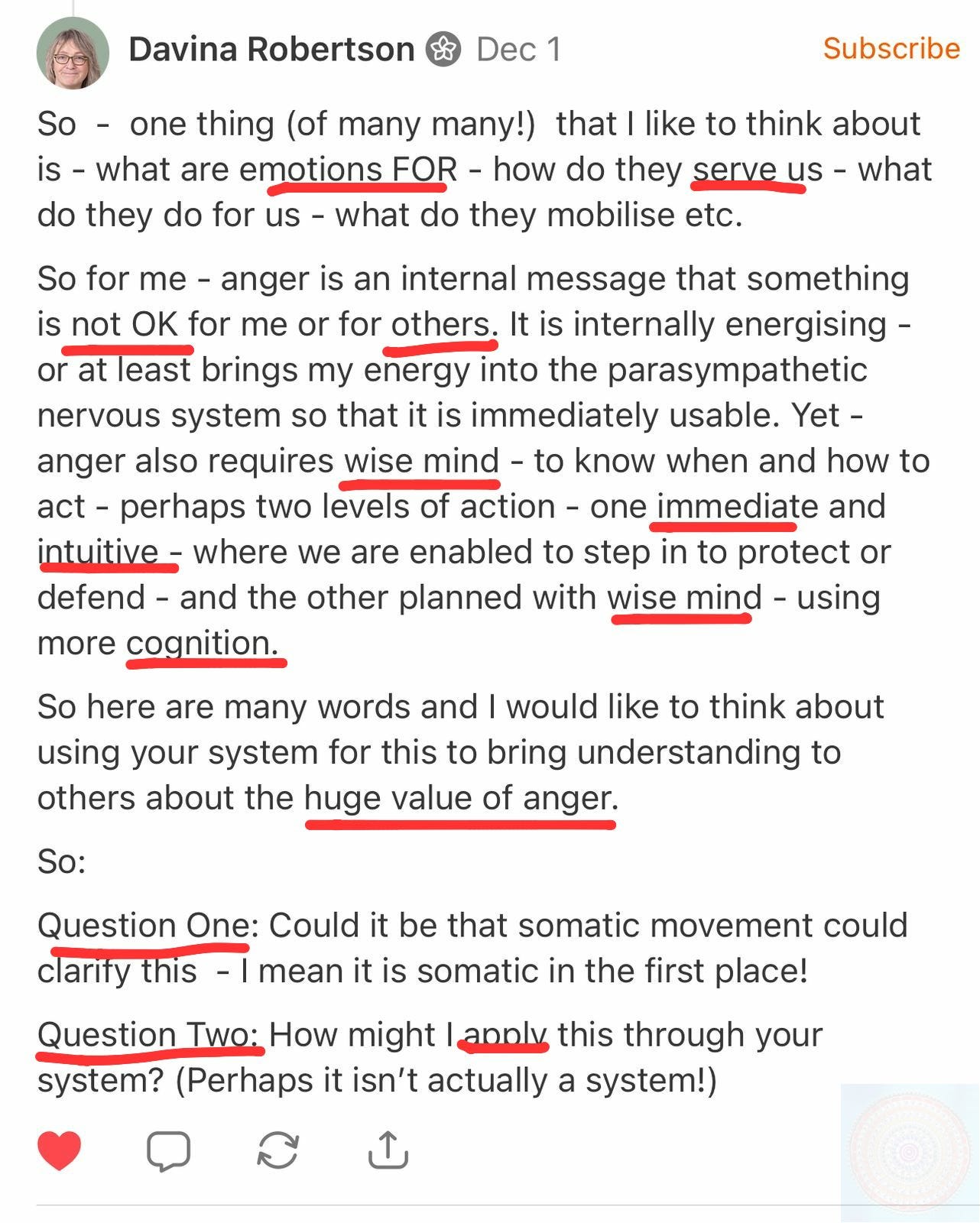
Davina’s questions, are the very SOUL of Somagraphic Learning.
So here is the clearest way to see anger through Shape → Motion → Emotion, using the visual-emotional grammar I’m developing.
1️⃣ What Anger Looks Like in Somagraphic Learning
Somagraphic Learning is a visual grammar.
A way to turn felt experience into shapes and motions that reveal the body’s logic before words arrive.
Below is the hand-drawn diagram:
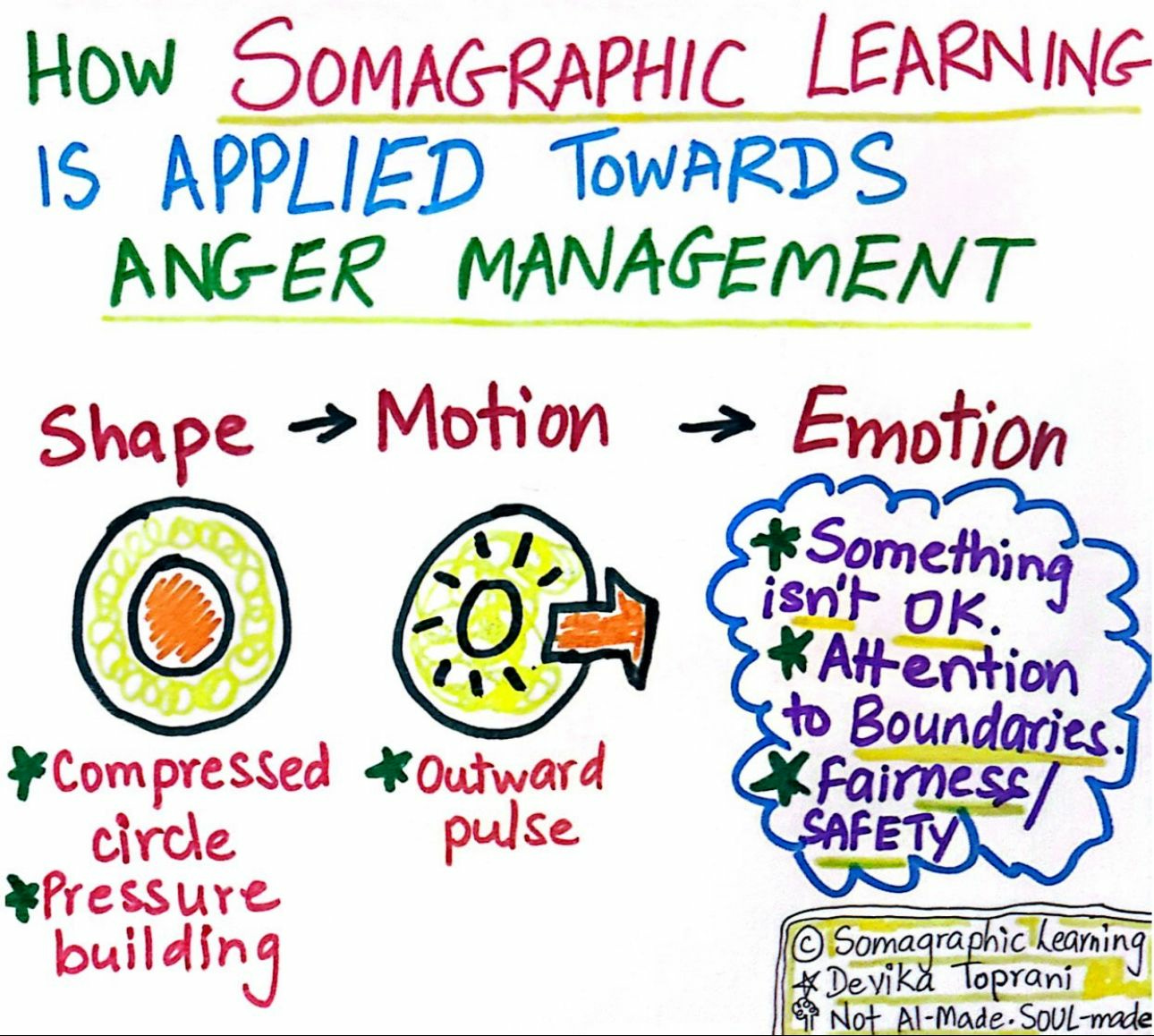
This is anger’s internal structure:
1️⃣ SHAPE - “Pressure”
A compressed circle.
Two tight rings.
A sense of squeeze.
The body says:
“A boundary is being pressed.”
Shape shows the origin of the emotion… the moment where internal space begins to shrink.
2️⃣ MOTION - “Activation”
A bold arrow pushing outward.
Direct, not destructive.
Movement that restores integrity.
The body says:
“I need to respond.”
Motion clarifies the difference between reactivity and readiness.
3️⃣ EMOTION - “Purpose”
Under the drawing, write three lines:
Something isn’t OK
A boundary needs attention
Energy is available to protect or correct
Anger becomes clarity, not chaos.
This is what Davina described:
Anger as information, energy, and protection.
2️⃣ How to Draw It (Step-by-Step)
Here is the drawing sequence:
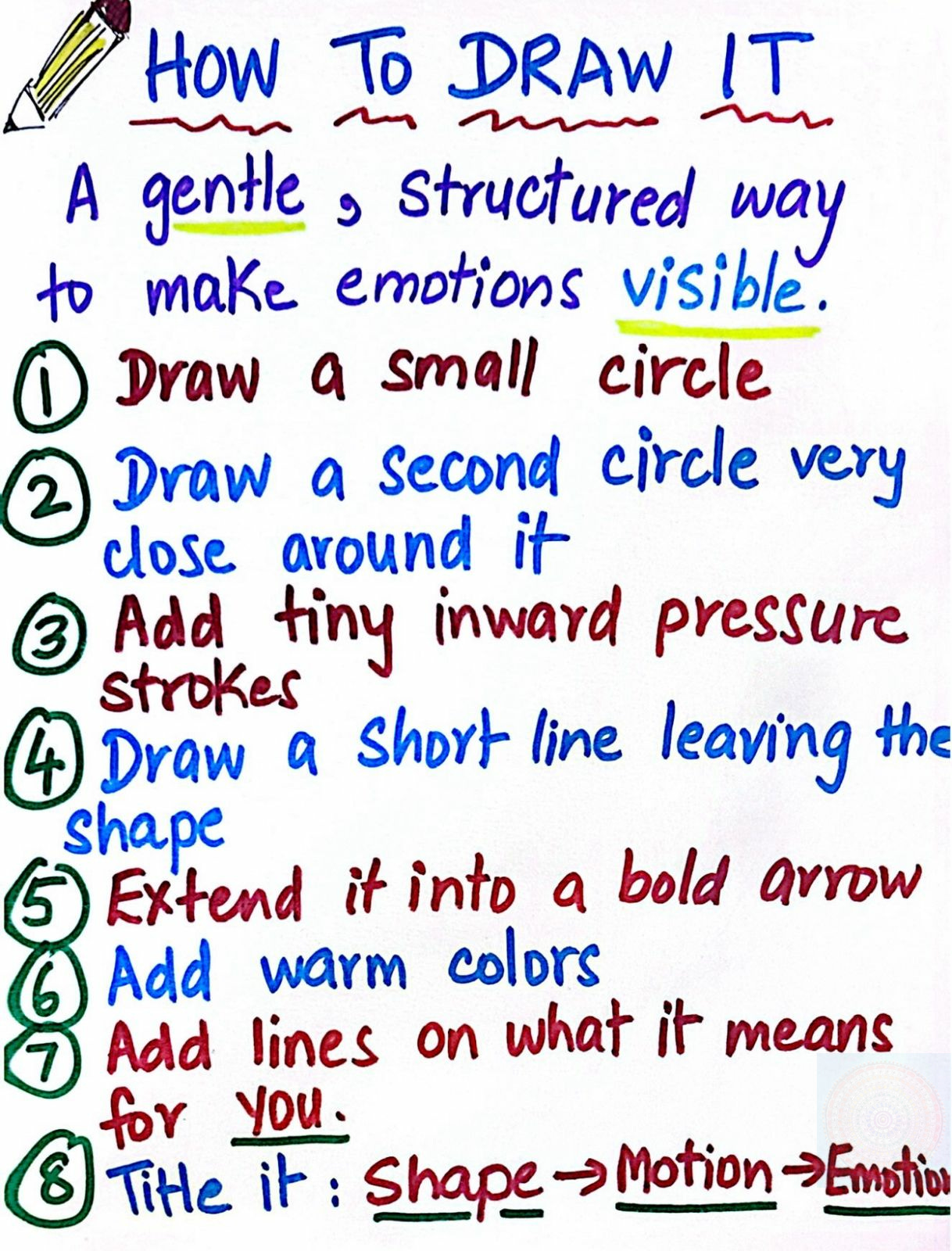
Now the internal message of anger is visible…
without needing long explanations.
3️⃣ Why This Helps (Across Therapy Rooms + Classrooms)
Somagraphic Learning gives anger a form that people can see:
✔ Makes anger non-threatening
A simple diagram reframes anger as information, not misbehavior.
✔ Supports non-verbal and intuitive thinkers
Not everyone processes emotions through words.
But anyone can understand a circle and an arrow.
✔ Reveals reactive vs. wise anger
The diagram shows exactly where the pause point lives.
✔ Integrates somatic therapy with cognition
Anger begins in the body.
Drawing reveals the sequence the nervous system already follows.
✔ Creates a repeatable grammar for all emotions
Once anger is mapped, the same Shape → Motion → Emotion sequence clarifies:
fear
sadness
overwhelm
anxiety
resentment
Each emotion has its own signature.
🌿 This is EXCITING! (…And surprising for me!)
After I shared my hand-drawn Somagraphic response, Davina created her own version.
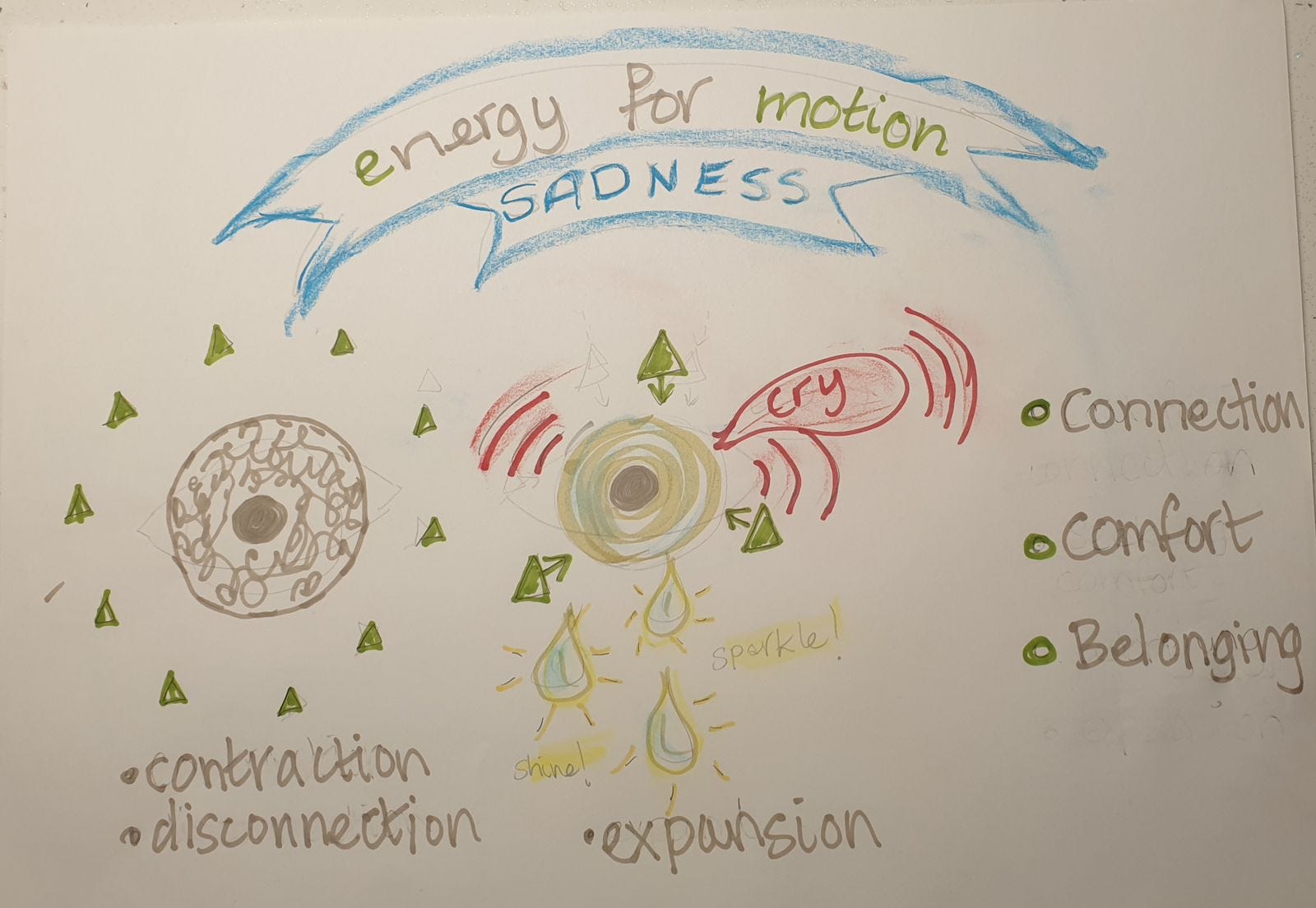
🌸 She not only tried it… she went on to draw ‘sadness’ and ‘fear’ too.
Here’s Davina’s version for ANGER.
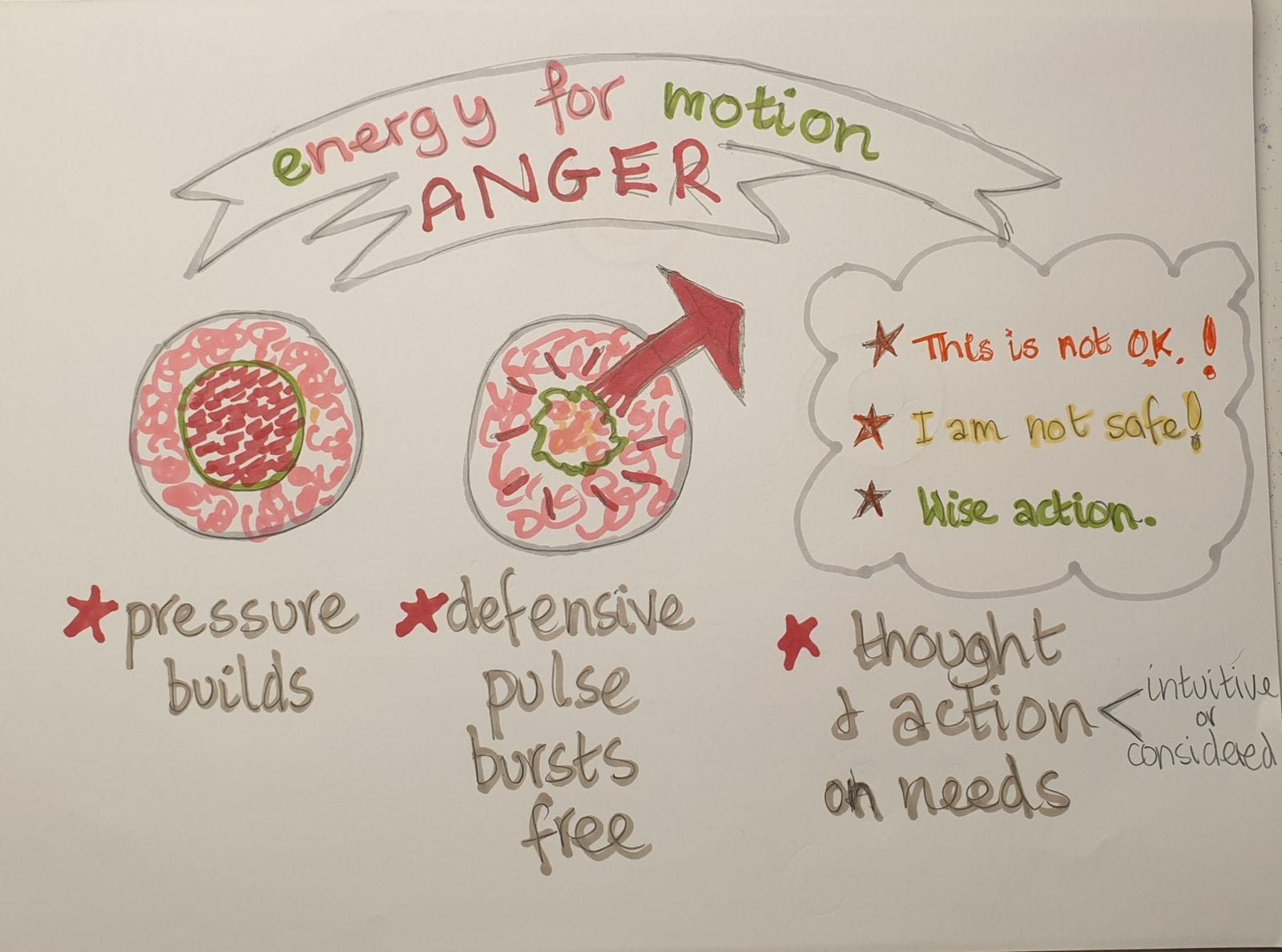
And here’s her version for SADNESS.
🌿 How did she FEEL after drawing these emotions?
Here’s Davina’s response:
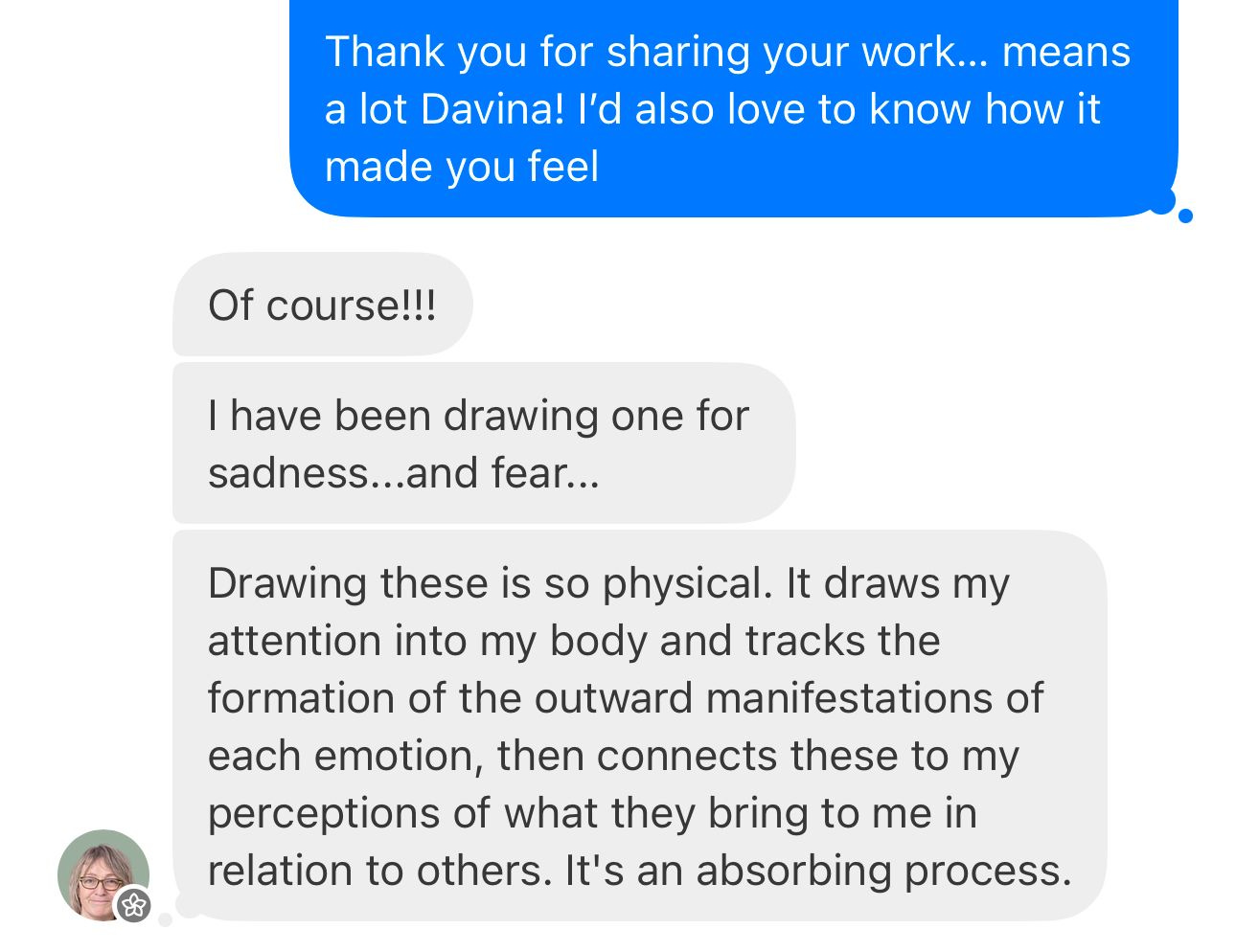
✍️ Her reflection was powerful.
The visual made the feeling CLEARER than words!
🌿 A Note to Davina
Thank you for opening this conversation… it expands the emotional language we’re building as a community.
If you or other Substack readers have specific questions or require visuals for other emotions, I’d be happy to create them.
Please feel free to shoot me a DM or connect via LinkedIn.
✨ Reflection
Somagraphic Learning isn’t about perfect art.
It’s about making the internal world visible.
🤖 Scaling this with AI
🦋 This approach also encourages something RARE…
Reflection through hand-drawn doodles, NOT through AI.
(AI can support, but the ‘felt’ insight comes from drawing.)
✨ This is the HUMAN-FIRST logic that shapes emotional drawings… a visual grammar I can train AI to replicate with my doodles.
Giving learners, clients, therapists, and educators a gentle way to understand
what their bodies already know.
✍️ A stable reference people can use when drawing their own emotional states.
If you try this in a session, classroom, or journal,
I’d love to hear what emerges… 🌿💛
Wow!!! Thank you SO much Devika for this fabulous response to my question.
I am going to follow your steps and do my own exploration.
I am excited to think about this as a deep engagement and learning tool.
You are amazing!!!
This is a really interesting way to visualise anger.